Is 5 Inches Normal? What the Data Actually Says
Published May 11, 2026
Five inches erect puts you within a centimetre of the global average. Not “close enough to feel okay about it.” Genuinely, measurably average, the kind of number a clinician writes down and moves on from. If you came here braced for bad news, breathe out. The rest of this is just the why.
Where five inches actually lands
The best figure we have comes from Veale and colleagues (2015), who pooled clinician-measured data from up to 15,521 men. No self-reporting, no rounding up. Their headline number: average erect length is 13.12 cm, with a standard deviation of 1.66 cm. That’s about 5.16 inches. Average erect girth in the same review came out to 11.66 cm.
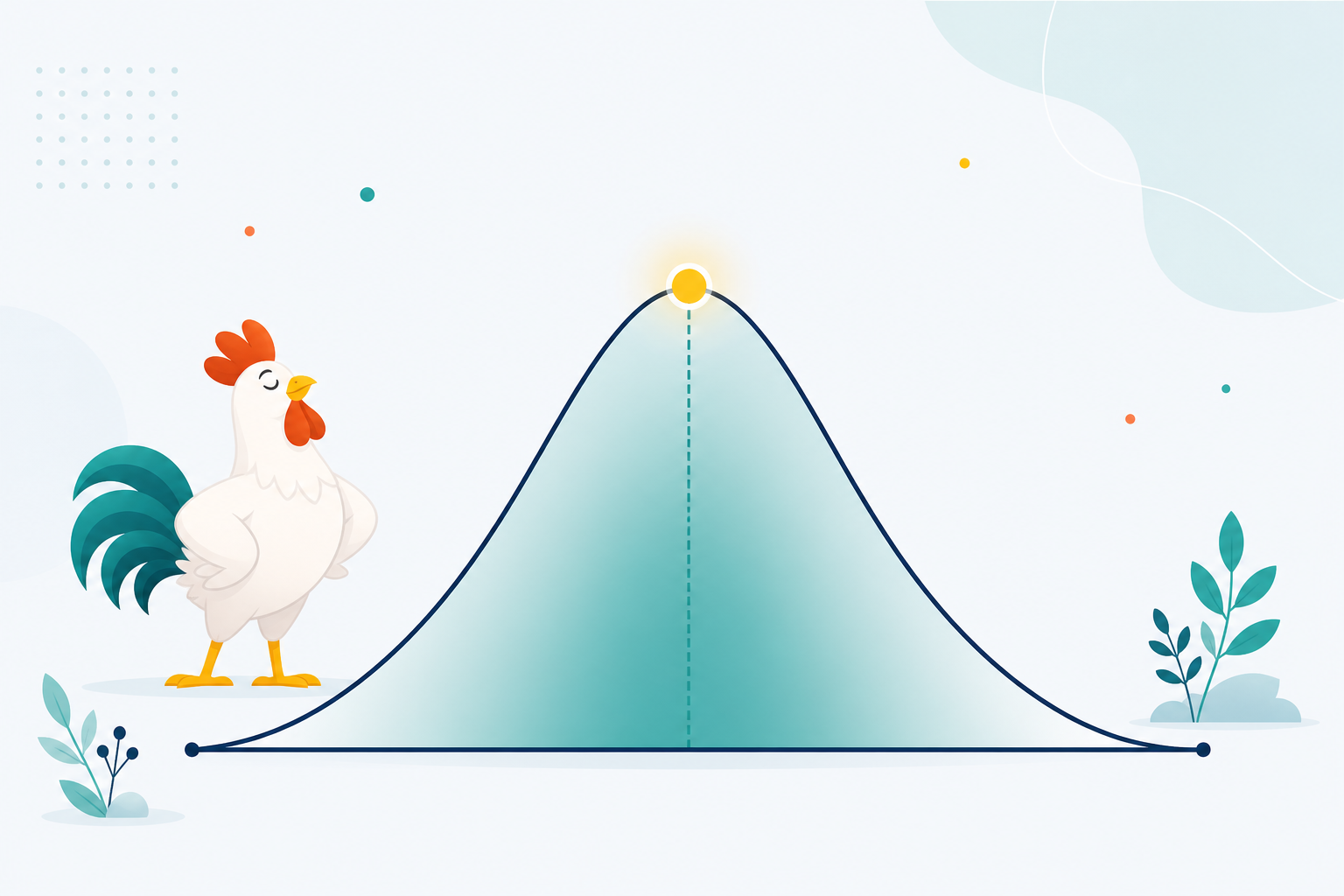
So where does a flat 5 inches sit? Five inches is 12.7 cm, about 0.42 cm under the mean, roughly a quarter of one standard deviation. On the bell curve that puts you near the 40th percentile, which means something like four in ten men measure shorter than you. You’re not on the edge of anything. You’re parked in the crowded middle of the curve, where most men live.
Want to see your own number plotted instead of mine? The percentile calculator does it in a couple of seconds and runs entirely in your browser, so nothing gets sent anywhere. Same Veale data underneath, which you can inspect on the methodology page.
What a quarter of a standard deviation actually means
“Near the 40th percentile” is easy to nod at and hard to feel. So picture the standard deviation as the natural width of human variation: the amount real bodies wobble around the mean for no reason at all. At 1.66 cm, one full standard deviation is about two-thirds of an inch. The gap between five inches and the average is a quarter of that. We’re talking about four millimetres. The thickness of a few stacked coins.
Put it another way: line up a hundred men by erect length. The man at five inches stands roughly fortieth from the short end, and the man directly ahead of him (the literal median, the most ordinary length there is) is so close you couldn’t eyeball the difference across a room. Nobody in that line could tell you who’s who without a ruler, and a good one, pressed correctly. The percentile machinery makes small gaps sound like places in a race. They aren’t. They’re noise that happens to have a number stuck to it.
And here’s the part that should land hardest: nudge five inches up by that same four millimetres and you’re above the median. The thing you’re worried about lives entirely inside the margin where measurement technique, time of day, and how long you’ve been standing matter more than anything written in your genes.
Why “average” stopped feeling like good news
The word “average” should be reassuring, and for almost everything else it is. Nobody loses sleep over an average shoe size. But somewhere along the line, “average” started reading like a polite word for “not enough.” That isn’t a fact about anatomy. It’s a broken baseline, and three things keep breaking it.
Porn is the obvious culprit. Performers are picked, explicitly, as a hiring requirement, for being outliers. Watch enough of it and your sense of “normal” drifts up toward the 95th percentile, a bit like concluding you’re short because you keep watching the NBA. And it isn’t only the casting. Low camera angles, careful framing, performers chosen partly for smaller hands, foreshortening that runs the opposite direction from how you see yourself: the whole production exists to inflate one number. You’re comparing your unedited body to a special effect.
Then there are self-reported surveys. When men fill in their own numbers, the totals run conspicuously large, because people round up, measure on a good day, or just remember the flattering version. Clinician-measured studies like Veale’s come in smaller and more honest, because a stranger with a ruler has no feelings to spare for yours. If a “men report 6+ inches on average” headline ever made you feel behind, that headline was measuring optimism, not anatomy. We get into exactly how shaky various studies are in how accurate are penis-size studies.
The third distortion is the most personal, and you do it to yourself daily. You look down at your own body from above, foreshortened, while a partner sees you side-on at full length. The viewing angle alone trims perceived size every time you glance down. Your eyes have been lying to you for years, and they lie consistently, which is why the man who’d guess himself a touch small from the top-down view is usually the same man a tape measure files as flatly average.
How wide “normal” really is
One average number makes it sound like there’s a single correct size and everyone else is being graded against it. The spread tells a kinder story. About 90% of men fall between roughly 10.7 cm and 15.5 cm erect, nearly five centimetres of range, all of it squarely inside “normal.” Five inches sits a touch below the centre of that band.
It’s worth sitting with how broad that is. Nearly two full inches separate the man at the 5th percentile from the man at the 95th, and the medical verdict on both is identical: normal, healthy, unremarkable. There’s no clinic on earth where a 12.7 cm measurement raises an eyebrow. The range isn’t a leaderboard with a pass mark somewhere in the middle. It’s the shape of a population: most people clustered near the centre, a thinning crowd toward each edge, and a flat five inches sitting comfortably inside the densest part. If you want to see how the curve shifts country to country (spoiler: barely, once you control for measurement method), the country-by-country breakdown lays it out.
Real medical smallness is rare and precisely defined. Micropenis means a stretched or erect length under about 9.3 cm, roughly two and a half standard deviations below the mean. It’s an actual clinical diagnosis, it affects a tiny fraction of men, and it’s usually spotted in infancy. At 12.7 cm you clear that threshold by more than three centimetres, not a close call. If you want to know where the line comes from, what is a micropenis walks through it without the drama.
The technique that’s quietly stealing your number
Of everything on this page, sloppy measurement is the single most common reason a perfectly average man convinces himself otherwise. Remember the math from earlier: the whole gap between five inches and the median is about four millimetres. A bad measurement can erase that gap, or invent one twice its size, without a single thing changing about your actual body.
The biggest offender is the pubic fat pad. Soft tissue at the base hides length, and the more of it there is, the more it hides. Clinicians correct for this by pressing the ruler in hard, right down to the pubic bone, which is why a clinic measurement often beats a bathroom one by the better part of a centimetre. Measure on top of the pad and you’re not measuring your penis; you’re measuring your penis minus however much padding is in the way.
Then there’s the rest of the checklist, each item worth a few millimetres of honesty:
- Measure from the top, bone to tip. The underside curve adds nothing real and varies with how you hold things.
- Be fully erect, and recently so. A not-quite-there erection reads short, and the difference is exactly the range you’re anxious about.
- Room temperature matters. Cold shrinks things noticeably; that reading is weather, not anatomy.
- Stand up straight. Slouching over the ruler reintroduces the same foreshortening that fools your eyes from above.
Do it the clinical way once, properly, and a lot of men find the “problem” was a fat pad and a soft angle the whole time. The how to measure guide has the full method, but the headline is simple: measure badly and you’ll find bad news, because you went looking for it with a crooked tool.
What partners actually say they prefer
Most of the “data” floating around about partner preferences is folklore in a lab coat. The good study here is Prause and colleagues (2015), and they did something clever. Instead of asking women to recall or imagine sizes, notoriously useless, they handed them a set of 3D-printed models and told them to pick. For a long-term partner, women’s choices clustered just slightly above average, nowhere near the dramatic extremes anxiety keeps predicting.
And here’s the finding that always gets buried under the panic: girth mattered at least as much as length. That one result quietly takes the air out of a lot of worry, because length is the dimension men fixate on and the one porn inflates hardest. If you want the full case for why circumference pulls more weight than people assume, girth vs length is the deep version, and does size matter covers what the satisfaction research actually shows.
There’s a quieter finding underneath all of it, and it’s the one worth tattooing somewhere: the things partners reliably name as what makes sex good (attentiveness, confidence, communication, whether you’re actually present) aren’t measured in centimetres at all. The man fretting about four millimetres mid-encounter is handing away the things that genuinely move the needle in exchange for a worry that, by the data, almost nobody on the other side is keeping score of.
The numbers that predict nothing
While we’re throwing out folklore: your height doesn’t reliably predict your size. Neither does your shoe size. Neither does race, no matter how stubbornly that myth refuses to die. Researchers have gone looking, repeatedly, and the correlations come back weak to nonexistent. So if you’ve been doing nervous arithmetic with your foot size, put the calculator down. The height/shoe/race myths gathers what the studies actually found.
It’s worth naming why these myths stick, because it’s the same reason five inches feels small. They’re tidy. The brain loves a clean rule (big feet, big everything), and a clean rule that confirms an existing worry is twice as sticky. But bodies don’t grade on a curve where every measurement moves together. The correlations exist on paper only in the sense that almost everything correlates a hair with almost everything; press on them and they collapse. Your shoe size tells a salesperson which shoe to fetch, and nothing else.
There’s a practical payoff to knowing your real numbers, and it has nothing to do with anxiety: condoms fit better when you buy by girth instead of guessing. A properly fitted one feels better and stays put. The condom-size guide maps measurements to sizes if that’s useful.
So what do you do with this?
Five inches is textbook normal. It sits near the middle of the range the overwhelming majority of partners describe as satisfying, and it’s more than three centimetres above any clinical concern. The number is fine. So if it’s still nagging at you after all of this, if the worry is bending how you feel, or how you show up with a partner, that’s real, and it deserves a conversation with a clinician or therapist far more than another date with the tape measure. Size anxiety tends to loosen its grip once you say it out loud. Rulers, in my experience, only ever hand it more to chew on.
FAQ
Is 5 inches enough to satisfy a partner? By the data, yes. Prause and colleagues (2015) found partner preferences for a long-term partner cluster just slightly above average, which five inches is right alongside, and that girth mattered at least as much as length. The dimension anxiety fixates on isn’t the one the research says carries the weight.
Can I make five inches bigger? There’s no pill, pump, or exercise with credible evidence behind it, and several carry real risk of injury. The better question is whether the number needs changing at all: at the 40th percentile it doesn’t, medically speaking. If the worry is loud, that’s a sign to talk to a clinician about the anxiety, not to chase millimetres.
Why does five inches look smaller than the tape measure says? Two reasons, both fixable. The top-down angle foreshortens everything you see, and a pubic fat pad can hide a centimetre of real length. Measure the clinical way (ruler pressed to the bone, along the top, fully erect) and the number usually jumps closer to what a partner already sees. How to measure has the method.