Measuring a Curved Penis: The Right Method and When a Curve Needs a Doctor
Published February 24, 2026
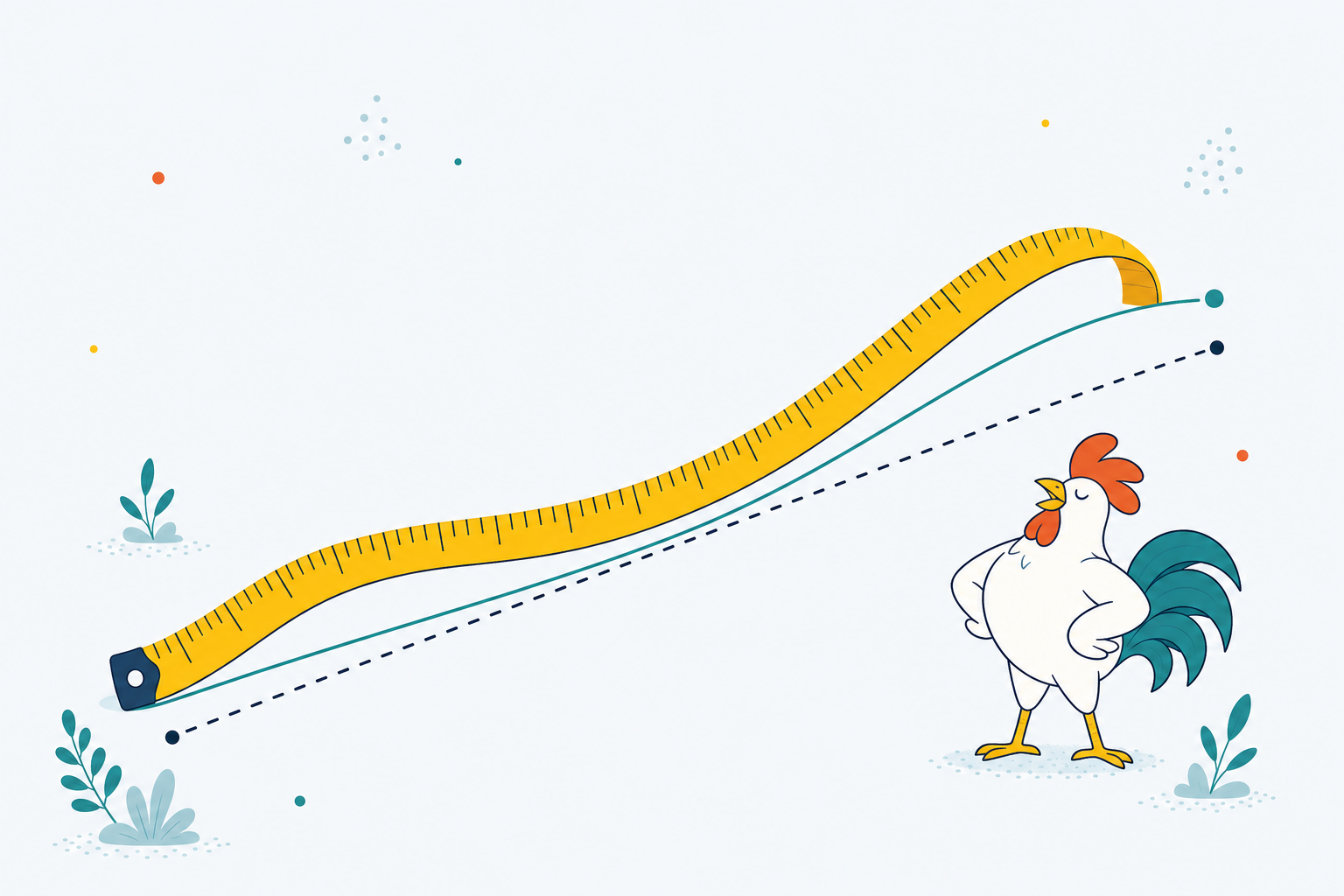
A bend in the shaft trips up almost everyone the first time they reach for a ruler. Lay a straight edge against a curved erection and it bridges the arc like a plank thrown across a ditch, shorting your length by a quarter-inch or more, depending on how sharp the bend is. The fix is simple once you know it. The bigger thing to know is that most curves are normal anatomy, not a defect. A penis is a hydraulic structure, not a steel rod. Some lean left, some point up, some dip down. Here’s how to get an honest number off a curved shaft, how it stacks up against the data, and the specific signs that mean it’s worth a urologist’s time.
Why a curve skews your number
Picture the inside of a banana versus the outside. The outer arc is longer than a straight line drawn point to point. Your erection behaves the same way. Measure length the lazy way, with a rigid ruler held flat along the top, and you’re recording the chord across the curve, not the actual length of tissue. The more the shaft bends, the wider the gap between those two numbers.
This matters because the figure you’ve half-memorized from the internet was collected a particular way. The largest clinician-measured dataset we have, Veale and colleagues’ 2015 review of 15,521 men, put average erect length at 13.12 cm (5.16 in) and average erect girth at 11.66 cm (4.59 in). Those clinicians measured along the dorsal (top) surface, and they bone-pressed: ruler pushed firmly into the pubic bone, fat pad compressed. Measure your own curved shaft with a stiff ruler held off to one side and you’re not measuring the same thing they did, so the comparison falls apart. Match their method or the percentile means nothing. Our full methodology page lays out exactly how the reference numbers were taken.
The right way: follow the curve along the top
You want a flexible tool. A cloth tailor’s tape, a strip of paper you’ll mark and lay flat after, or a length of string all work. A rigid ruler is the one thing you shouldn’t reach for with a curved shaft, because it can’t trace the bend.
Do it like this:
- Get fully erect. Half-mast readings are noise. Wait until you’re as hard as you get, standing up.
- Find the base on top. Press the end of your tape into the pubic bone at the top of the shaft and push until the soft fat pad gives and you feel bone. This is the bone-pressed start point, and it’s what the research uses. Skip the press and you’ll read 1–2 cm short, purely because of the fat pad sitting in front of the bone.
- Lay the tape along the dorsal surface, hugging the curve. Let it ride the arc, up over the bend and back down toward the tip, so it follows the tissue instead of cutting across it.
- Stop at the tip of the glans, not the urethral opening, which can sit slightly recessed.
- Read the number, then do it twice more and take the middle value. Erections shift with time of day, temperature, and arousal. One reading is a data point; three is a measurement.
Girth barely cares about the curve. Girth is circumference, so wrap the flexible tape around the thickest part of the shaft, snug but not strangling, and read where it meets. The bend doesn’t change that loop. Worth remembering when you size protection: a tape around the middle is exactly what our condom size calculator wants from you, and girth, not length, governs fit.
Curve method vs straight-line: which number is “real”
Here’s the honest answer most sites dodge. Both numbers are legitimate. They just answer different questions.
- The curve measurement (tape along the top, following the bend) tells you how much erectile tissue you actually have. It’s the larger of the two, and it’s the better self-comparison against published averages, since clinicians measured along the dorsal surface.
- The straight-line measurement (tip to bone, ignoring the arc) tells you the functional reach: roughly how far the penis projects in a straight line. It’s smaller, and arguably more relevant to how a given position feels in practice.
For comparing yourself to a chart, use the curve number and bone-press the base. That’s the apples-to-apples figure. Drop it into our percentile calculator and you’ll see where you land. To set expectations first: median erect length is 13.1 cm (5.2 in), the 25th percentile is 12.0 cm (4.7 in), the 75th is 14.2 cm (5.6 in), and roughly 90% of men fall between 10.4 and 15.9 cm (4.1–6.3 in). In inches, 5 inches sits right around the 40th percentile, squarely normal despite what the internet implies. We pick that exact number apart in is 5 inches normal.
One trap to flag. The gap between bone-pressed (BPEL) and non-bone-pressed (NBPEL) is bigger than the curve correction for most men. The fat pad can hide 1–2 cm. So if your reading feels low, check whether you pressed to bone before you blame the bend. The press changes length; it doesn’t touch girth.
What counts as a normal curve
Some bend is the default, not the exception. The erectile chambers rarely inflate with perfect symmetry, so a slight lean (up, down, left, right) is ordinary and usually permanent in a perfectly harmless way. If you’ve curved gently in the same direction for as long as you’ve had erections, that’s congenital curvature: built-in, painless, and almost always nothing to treat.
A decent gut check is angle plus history. A bend up to around 30 degrees that’s been stable for years, doesn’t hurt, and doesn’t get in the way of sex is the kind of thing urologists reassure men about routinely. The shape matters less to your partner than you’d fear, too. When researchers asked women to pick ideal proportions from 3D-printed models (Prause, 2015), preferences clustered just slightly above average, around 16.0 cm length and 12.2 cm girth for a long-term partner, and girth mattered at least as much as length. Curve direction never dominated the conversation. Most women, survey after survey, report being satisfied with their partner’s size. If you’re spiraling over a lifelong gentle bend, the data is firmly on your side.
When a curve is Peyronie’s, and worth a doctor
The line you actually need to watch isn’t “do I curve?” It’s “did this change?” A congenital curve is the shape you’ve always had. Peyronie’s disease is a new curve, driven by fibrous scar tissue (plaque) forming inside the shaft, often after a minor, sometimes unnoticed, injury during sex. That distinction is the whole game. See someone if you notice:
- A curve that appeared or got worse recently, especially in adulthood, over weeks or months.
- Pain with erections or during sex. Congenital curves don’t hurt.
- A palpable lump or hard band along the shaft. That’s the plaque.
- A sharp angle, hourglass narrowing, or an indentation rather than a smooth, gentle arc.
- Difficulty with penetration, or a curve severe enough to make sex impractical.
- New trouble getting or keeping an erection alongside the bend.
Any one of those earns a visit to a GP or urologist. Peyronie’s is common, it’s treatable, and outcomes are far better when it’s caught early. In the active phase there are options that lose their window once the scar matures. None of this is an emergency in the ambulance sense, but it’s not a wait-a-year situation either. Separately, and unrelated to curvature: an erection that won’t subside and turns painful after a few hours is priapism, and that one is a same-day problem.
Curvature itself says nothing about whether your size is in a healthy range. That’s a different axis entirely. The clinical threshold for micropenis is a stretched length under about 9.3 cm, which affects roughly 0.6% of men, and a curve has no bearing on it.
A quick reality check on the numbers
Before you read too much into a single session: your erection isn’t a fixed object. It changes with arousal, temperature, how recently you last finished, and the time of day. The flaccid state is even less predictive. Average flaccid length runs about 9.16 cm (3.6 in), but flaccid-to-erect ratios swing wildly between men, which is the whole grower vs shower phenomenon. A small flaccid penis tells you almost nothing about erect size. See flaccid vs erect for the full picture.
Once you’ve finished puberty, typically around 17 to 19, your size is essentially stable for the rest of adult life. Those charts claiming a precise average for every single adult age are, bluntly, made up. We explain why in average penis size by age. What can change in adulthood is a curve, which loops right back to the one signal worth tracking: not the shape itself, but a shape that’s shifting.
FAQ
Does a curved penis measure shorter than a straight one? Only if you measure it wrong. A rigid ruler held flat against a curved shaft cuts across the arc and reads short by anything from a few millimeters to over a centimeter, depending on the bend. Use a flexible tape that follows the curve along the top, bone-press the base, and you’ll capture the true length. The curve isn’t costing you size. The ruler is.
Should I compare my curve-measured length to the average? Yes, as long as you measured the way the research did: flexible tape along the dorsal surface, pushed into the pubic bone. That matches the clinician-measured average of 13.12 cm (5.16 in) erect. Don’t compare a non-bone-pressed straight-line number to a bone-pressed clinical average, or you’ll undersell yourself by 1–2 cm for no reason. Run your figure through our calculator or browse the statistics for context.
How much curve is too much? There’s no single magic angle. The practical answer is about change and pain, not degrees. A gentle bend up to roughly 30 degrees that’s been stable your whole adult life, hurts nothing, and doesn’t get in the way of sex is normal. A curve that’s new, worsening, painful, comes with a lump, or makes sex difficult points toward Peyronie’s disease and is worth a urologist. When in doubt, get it looked at. Early Peyronie’s treats far better than late.